Amsterdam is a city that makes an outsized impression relative to its actual size. It is, in geographic terms, not large: the historic centre can be crossed on foot in twenty minutes. But within that compact footprint it has managed to accumulate an exceptional density of museums, one of the world's great canal systems, some of the most thoughtfully designed urban architecture of the 17th century, and enough of its own complicated history to keep a curious visitor occupied for considerably longer than most people allow. The city repays slow exploration far more than it rewards a checklist approach.
Amsterdam's major museums operate on timed-entry tickets that must be booked online in advance. This is not optional advice – several attractions sell out weeks or months ahead and have no walk-up tickets at all. Sort this out before you leave home, not when you arrive at the door. Prices below were correct when we wrote this; check the official sites before your visit.
The Rijksmuseum is the national museum of the Netherlands and the most visited attraction in Amsterdam, which it earns through the quality of its collection rather than through any shortage of alternatives. The building itself – a vast red-brick neo-Gothic palace on Museumplein, designed by architect P.J.H. Cuypers and completed in 1885 – is the kind of place that sets expectations high before you step through the door, and the collection meets them. Over 8,000 objects covering 800 years of Dutch art and history are spread across 80 galleries, with the centre of gravity firmly in the 17th-century Dutch Golden Age.
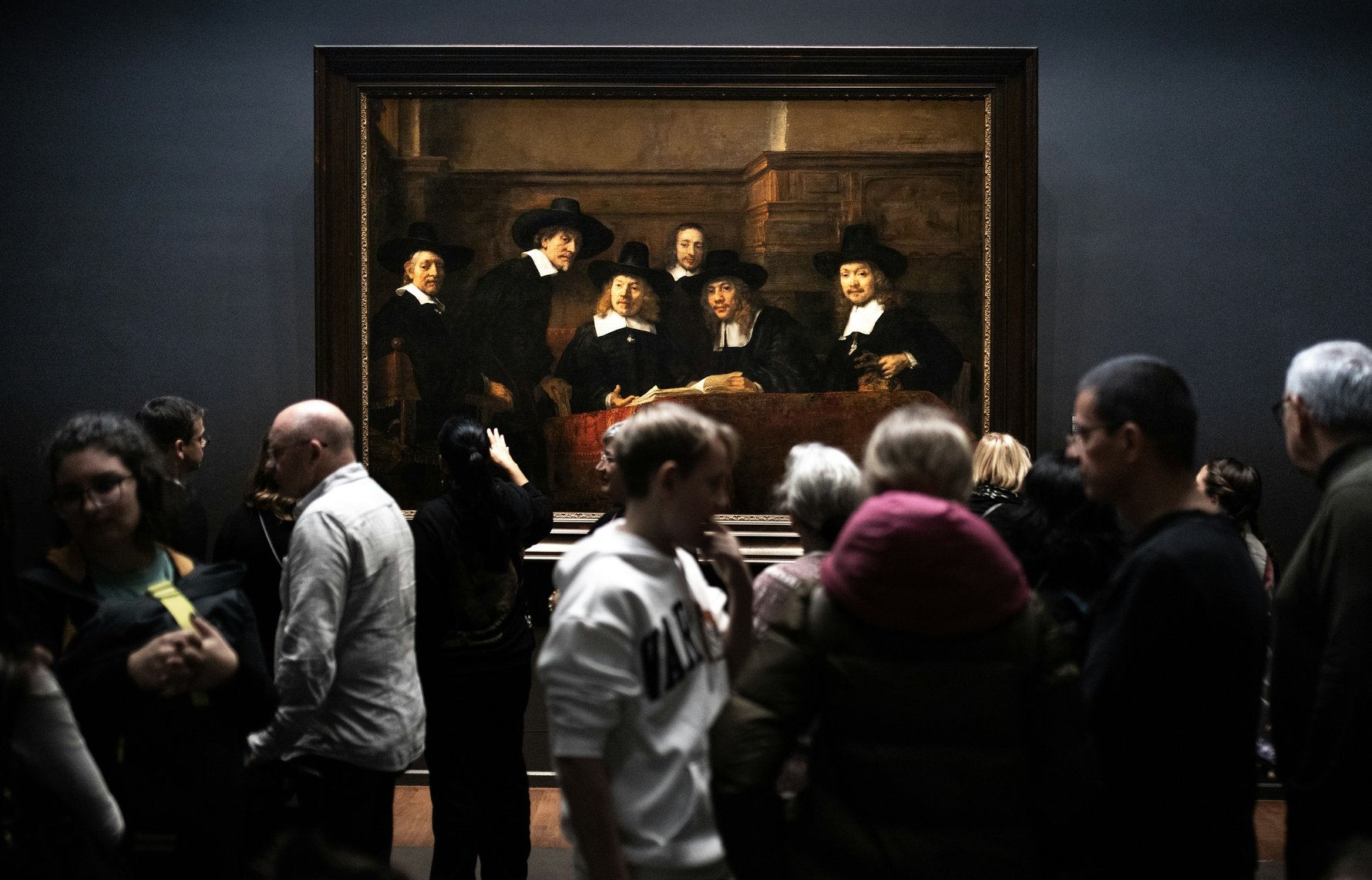
The masterpieces need no introduction but deserve attention in person. Rembrandt’s Night Watch (1642) hangs in its own gallery, 3.63 metres tall, and commands the kind of silence that most famous paintings do not actually achieve. Vermeer’s The Milkmaid – small, still, and technically extraordinary – is nearby. Van Gogh made a self-portrait of the Night Watch a reason he would gladly give up ten years of his life. The collection also encompasses Delftware, Dutch maritime history, Asian decorative arts, and a sculpture garden that is free to enter. Allow at least half a day, preferably more.
Location: Museumstraat 1, Museumplein. Tram 2, 12 or bus 197 to Museumplein.
Best time to visit: Tuesday or Wednesday mornings at opening (9am) for the thinnest crowds. Weekends in summer are best avoided.
Ticket prices: €23.50 for adults; free for under-18s. Online booking with a timed entry slot is mandatory. No tickets are sold at the door.
Good to know: The Cuypers Library, the oldest and largest art history library in the Netherlands, is inside the museum complex and free to visit independently of the main collection. The reading room is among the most beautiful interiors in Amsterdam.
2. Anne Frank House
The Anne Frank House is one of the most quietly devastating places in Europe. Between July 1942 and August 1944, Anne Frank, her parents, her sister Margot and four other Jewish people hid in the concealed rear annexe of a canal house at Prinsengracht 263, where Anne’s father Otto Frank had his business. Anne spent most of those two years writing the diary that would be published after the war, read by more than 30 million people, and translated into over 70 languages. In August 1944 the annexe was betrayed. All eight of its residents were deported. Anne died in Bergen-Belsen concentration camp in February 1945, shortly before liberation.
The house is preserved more or less as it was found. The rooms are small, the staircase steep, and the experience of moving through the hidden annexe – seeing Anne’s diary entries on the walls, the height marks her father pencilled as the children grew, the photographs she pasted up to make the space feel less confining – is more affecting than almost any comparable historical site. The audio tour, which includes excerpts from the diary read in context, is included in the ticket price. Visiting the house is not a comfortable experience, and it is not supposed to be. It is necessary.
Location: Westermarkt 20 (entrance), Prinsengracht 263-267. Tram 13 or 17 to Westermarkt.
Best time to visit: Irrelevant – this is fully booked well in advance at almost all times. Book as early as possible.
Ticket prices: €16 for adults; €7 for ages 10–17. Tickets are released every Tuesday at 10am CEST for visits six weeks later. They sell out within minutes. No tickets are sold at the door, and no third-party resellers are legitimate.
Good to know: Large bags are not admitted. Leave luggage at your hotel or at the luggage storage at Amsterdam Centraal.
3. Van Gogh Museum
The Van Gogh Museum holds the largest collection of works by Vincent van Gogh in the world: over 200 paintings, 500 drawings and 750 letters, most of them belonging to the Vincent van Gogh Foundation established by his nephew. The collection traces the full arc of a career that lasted only a decade (1880–1890) and produced around 900 paintings – a rate of output that becomes more extraordinary the more you understand the circumstances under which it was achieved. Van Gogh sold exactly one painting during his lifetime.
The museum is arranged chronologically, moving from the sombre Potato Eaters period in the Netherlands through the explosion of colour in Paris and Provence. The Sunflowers are here. Almond Blossom is here – painted in 1890 for his brother Theo’s newborn son, in the most optimistic moment of a troubled life. The Japanese prints that influenced his shift toward flat planes of colour are displayed alongside the works they inspired. The permanent collection is accompanied by temporary exhibitions that draw from partner institutions worldwide. The Starry Night, frequently asked about, is at MoMA in New York. It is not here.
Location: Museumplein 6, a short walk from the Rijksmuseum. Tram 2, 12 or bus 197 to Museumplein.
Best time to visit: Weekday mornings. Book well in advance; the museum frequently sells out.
Ticket prices: €25 for adults; free for under-18s. Online timed-entry booking is mandatory.
Good to know: Tickets are only sold through the official Van Gogh Museum website. The museum is no longer affiliated with the I amsterdam City Card.
4. The Canal Ring
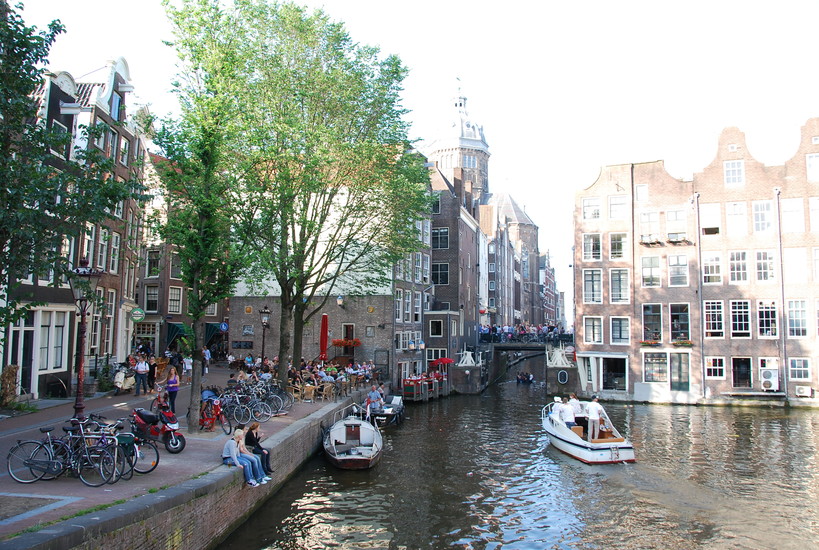
Amsterdam’s Grachtengordel – the Canal Ring – is not an attraction in the conventional sense so much as the physical context in which the entire city takes place. The three main concentric canals – Herengracht (Gentlemen’s Canal), Keizersgracht (Emperor’s Canal) and Prinsengracht (Prince’s Canal) – were dug between 1613 and 1665 as part of the most ambitious urban planning project of the 17th century, transforming a waterlogged polder on the edge of the North Sea into the largest planned city expansion of its time. The plots along the new canals were sold to wealthy merchants who built the narrow gabled houses that line them today. UNESCO recognised the canal ring as a World Heritage Site in 2010.
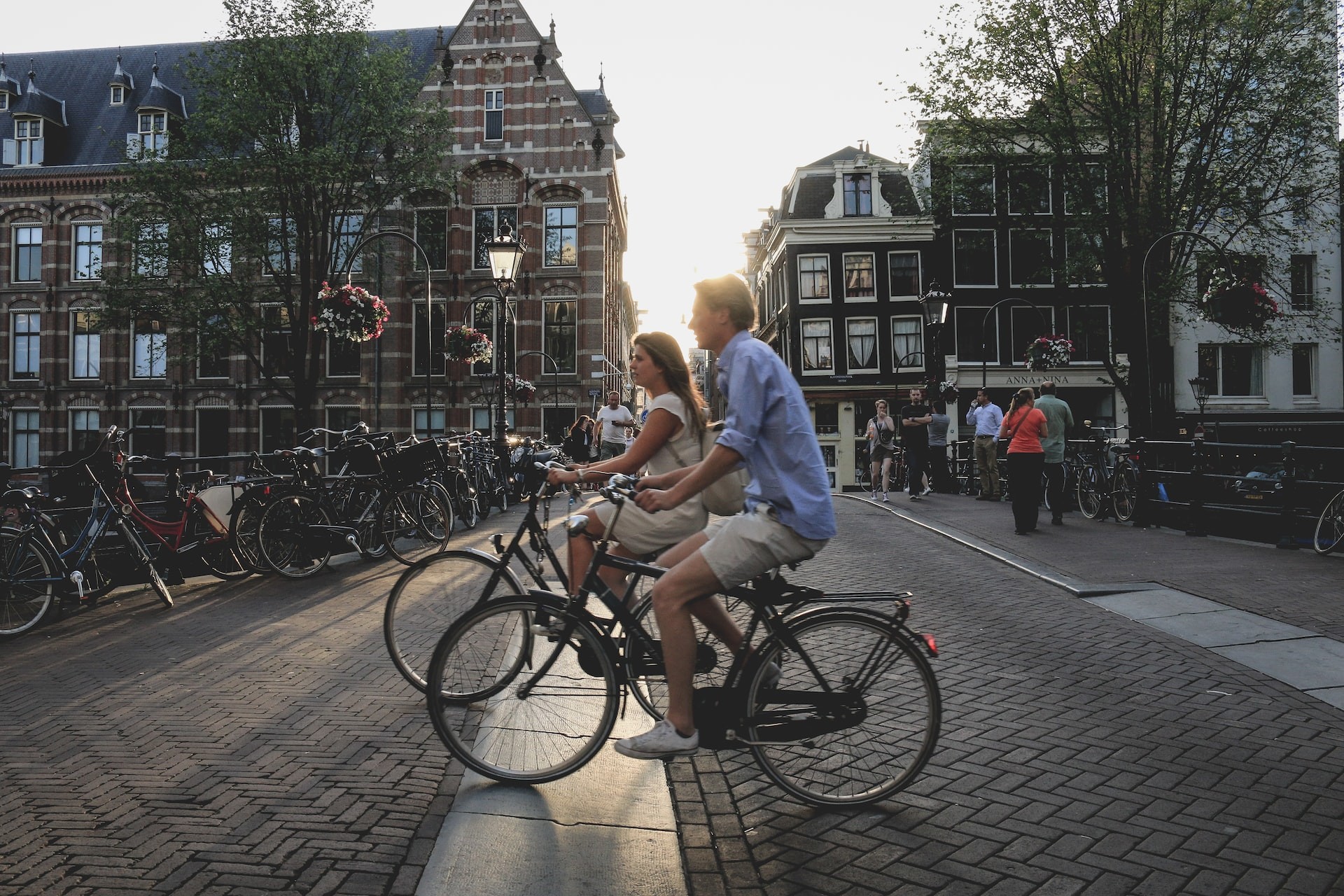
Walking or cycling the canals – ideally getting off the main tourist routes and onto the quieter side streets and smaller waterways – is the best way to understand why Amsterdam is the way it is. The houses lean forwards, deliberately, so that goods hoisted to the upper floors by the beam and pulley above each roofline would clear the facade. Many tilt sideways too, subsiding gently on their thousands of wooden piles driven into the marshy ground. The Golden Bend on the Herengracht, between Leidsestraat and Vijzelstraat, is where the wealthiest merchants built their widest and grandest houses in the late 17th century. A canal cruise – either a fixed tour or a rented boat – offers a different perspective on the same streets.
Location: The concentric canals form a crescent around the old city centre. The Prinsengracht is the outermost of the three main canals; the Jordaan neighbourhood lies just west of it.
Best time to visit: Early morning for photography, when the light on the water is best and the streets quietest. Evening in summer when the terraces are open.
Ticket prices: Free, since it is a public space. Canal cruises start at around €15 per person.
Good to know: There are more than 1,500 bridges across Amsterdam’s waterways. The most famous of these is probably the Magere Brug (Skinny Bridge) across the Amstel, a narrow wooden drawbridge that has been on this spot in various forms since 1691.
5. Stedelijk Museum
The Stedelijk Museum is the largest museum of modern and contemporary art and design in the Netherlands, housed in a 19th-century red-brick building on Museumplein with a startling white contemporary extension – nicknamed ‘the bathtub’ by Amsterdam locals, with a mixture of affection and resignation – added in 2012. The collection covers art and design from 1870 to the present, across painting, sculpture, photography, graphic design, industrial design and multimedia, and runs to around 90,000 objects.
The permanent collection is genuinely one of the great modern art holdings in Europe, with depth in areas where other museums have only highlights. The De Stijl movement is represented by Mondrian, Van Doesburg and Rietveld. There are major works by Matisse, Chagall, Malevich, Kandinsky, Picasso and Cézanne. The post-war collection includes Karel Appel (founder of the CoBrA movement and a central figure in Dutch art history), Willem de Kooning and Andy Warhol. The design collection traces the relationship between visual art and the manufactured world from the Arts and Crafts movement through the Bauhaus and into the present. The Stedelijk also runs an active programme of temporary exhibitions, usually of international significance.
Location: Museumplein 10, next to the Van Gogh Museum. Tram 2, 12 or bus 197 to Museumplein.
Best time to visit: Weekday afternoons, when the Museumplein crowd has thinned relative to the morning rush.
Ticket prices: €22.50 for adults; free for under-19s. Advance booking recommended but not mandatory.
Good to know: The Stedelijk is included in the I amsterdam City Card and the Dutch Museumkaart. Combining it with the Rijksmuseum and Van Gogh Museum in a single Museumplein day is ambitious but achievable if you are selective.
6. Westerkerk
The Westerkerk is Amsterdam’s most important Protestant church and, by some reckonings, its most emotionally loaded building. Built between 1620 and 1631 to designs by Hendrick de Keyser – one of the few purpose-built Protestant churches of the era rather than a repurposed Catholic one – it is the largest such church in the Netherlands, with an 85-metre tower topped by the blue Imperial Crown granted to Amsterdam by Emperor Maximilian I in 1489. The carillon was installed by the Hemony brothers in 1658, and plays every quarter-hour across the Jordaan and the canal ring.
Two facts about the Westerkerk give it its particular weight. The first: Rembrandt van Rijn was buried here in October 1669, in an unmarked pauper’s grave. He had died poor and alone; by custom, pauper’s graves were cleared after 20 years, so his remains are almost certainly no longer in the church, though a memorial plaque marks the north aisle. The second: the Westerkerk features repeatedly in Anne Frank’s diary. Its clock face was visible through a hole in the side of the annexe, and she wrote about the bells with affection, calling them reassuring. “Especially at night,” she noted. In August 1943 the Nazis took the bells away to melt down. They were saved by a lie told by city officials, and they ring still.
Location: Prinsengracht 281, directly adjacent to the Anne Frank House. Tram 13 or 17 to Westermarkt.
Best time to visit: Tuesday at noon, when the city carillonneur gives a free hour-long recital from the tower.
Ticket prices: The church is free to enter. Tower climbs run in summer and cost around €9 for adults.
Good to know: Princess Beatrix married Prince Claus here in 1966, because the Nieuwe Kerk on Dam Square (the traditional venue for royal weddings) was under renovation. The bells played, and the city turned out.
7. National Maritime Museum
The Het Scheepvaartmuseum – the National Maritime Museum – occupies the former arsenal of the Dutch Admiralty, built by Daniel Stalpaert in 1656 on the Eastern Docklands east of the city centre. At the time, this building was the logistical nerve centre of the most powerful naval and commercial fleet in the world: the Dutch East India Company (VOC) was at the height of its dominance, controlling the spice trade from Batavia (now Jakarta), and Amsterdam was the wealthiest city on earth. The building reflects that: it is serious, monumental architecture designed to house serious, monumental ambitions. A spectacular glass-and-steel roof added during a 21st-century restoration has transformed the inner courtyard into the heart of the museum.
The collection covers 500 years of Dutch maritime history with around 400,000 objects. The moored outside is a full-scale replica of the VOC ship Amsterdam, a 1748 East Indiaman that sank on its maiden voyage to Asia. You can board it, explore the decks and the cargo hold, and understand – in a way that text alone cannot convey – what it meant to spend months at sea in the 17th century in a space that smells of pitch and timber. Inside, the collection ranges from navigation instruments and antique atlases to paintings of naval battles and the extraordinary gilded Royal Barge commissioned in 1818 for King William I.
Location: Kattenburgerplein 1. Bus 22 or 48 from Centraal Station to Kadijksplein, two stops.
Best time to visit: Weekday mornings; the museum is less crowded than the Museumplein institutions and has ample space even in summer.
Ticket prices: €18.50 for adults; free for under-12s. Free with the I amsterdam City Card and the Dutch Museumkaart.
Good to know: The museum library holds nearly 60,000 books, some over 500 years old. The restaurant in the courtyard under the glass roof is one of the more pleasant places to have lunch in this part of the city.
8. De Jordaan
The Jordaan neighbourhood, immediately west of the canal ring, was built in the first half of the 17th century to accommodate the influx of workers, craftspeople and religious refugees that accompanied Amsterdam’s Golden Age expansion. It was laid out on the existing pattern of drainage ditches and meadow paths, which is why its streets follow a slightly different grid from the deliberate geometry of the canals. For much of its history it was a working-class district, densely populated and economically marginal; it was also where a significant number of Amsterdam’s Jewish residents and Huguenot refugees settled. Today it is the most characterful neighbourhood in the city, gentrified but not sanitised, full of independent shops, galleries, brown cafés (bruin cafés – Amsterdam’s version of a pub, named for their nicotine-stained ceilings and walls), street markets and some of the most photographed canalside streets in the country.
The Jordaan also contains Amsterdam’s hofjes – hidden inner courtyards that were originally built as almshouses for the poor and elderly, accessible through unremarkable doorways in the main street facades. There are around 40 of them in and around the Jordaan; some of the most beautiful include the Begijnhof (technically just outside the Jordaan in the city centre), the Karthuizerhofje on Karthuizerstraat, and the Suykerhofje on Lindengracht. They are quiet, green and almost entirely unknown to the visitors rushing between the Rijksmuseum and the Anne Frank House just a few streets away.
Location: West of the Prinsengracht, between the Brouwersgracht to the north and Leidsegracht to the south. Tram 13 or 17 to Westermarkt.
Best time to visit: Saturday morning for the Noordermarkt (organic food market and flea market) around the Noorderkerk. Weekday evenings for the brown cafés.
Ticket prices: Free. This is a neighbourhood, not an attraction.
Good to know: The Jordaan was not, despite persistent legend, named after the French word for garden (jardin). The name most likely derives from the Flemish pronunciation of the Jordaan river used by the Huguenot refugees who settled here after the Edict of Nantes was revoked in 1685.
9. Dutch Resistance Museum
The Verzetsmuseum – the Dutch Resistance Museum – is situated near Artis Zoo in the Plantage neighbourhood, a twenty-minute walk from the city centre, and is the kind of museum that reorders your priorities for the rest of the day. It tells the story of the Netherlands under German occupation from 1940 to 1945 through 100 personal stories of ordinary Dutch people: how the occupation felt in daily life, how the persecution of Jewish citizens unfolded, and how different people responded. Some collaborated, some turned a blind eye, some helped, some actively resisted. The exhibition does not simplify these choices.
The museum is unusual in its honesty about the range of responses to occupation, including the uncomfortable question of how the Netherlands’ own civil administration enabled the deportation of approximately 75% of its Jewish population – the highest proportion of any Western European country. Documents, photographs, authentic objects and films are used to build a picture that is consistently specific and individual rather than abstract and statistical. The Dutch-language section for children (Verzetsmuseum Junior), in which four children’s wartime experiences are followed, is one of the best museum experiences of its kind in Europe. The audio guide is included in the ticket price.
Location: Plantage Kerklaan 61. Tram 14 to Artis stop from Centraal Station.
Best time to visit: After 3.30pm on school days to avoid groups. The museum is open Monday to Friday from 10am and Saturday to Sunday from 11am.
Ticket prices: €16 for adults; €8.50 for ages 7–17. Free with the I amsterdam City Card and the Dutch Museumkaart.
Good to know: The museum is routinely described as Amsterdam’s best-kept secret by people who have been to both this and the Anne Frank House. It is not a replacement for the Anne Frank House; it is a companion to it.
10. Museum Ons’ Lieve Heer op Solder
Museum Ons’ Lieve Heer op Solder – Our Lord in the Attic – is a 17th-century canal house on the Oudezijds Voorburgwal in the old city centre, a few minutes’ walk from the Oude Kerk and directly in the middle of the Red Light District, which is an arresting combination of adjacencies. In 1663, a wealthy Catholic merchant named Jan Hartman commissioned a complete church to be built on the top three floors of the house. At the time, public Catholic worship was banned in Amsterdam following the Protestant Reformation – Catholic churches had been confiscated and converted – but the authorities adopted a policy of pragmatic tolerance toward hidden house churches, provided they were not recognisable from the street. The church in the attic of Hartman’s house was used for Catholic worship for over 200 years.
What makes the place remarkable is that the house and church have been preserved almost exactly as they were. You move through narrow corridors and steep staircases of a 17th-century canal house – seeing the furnished living rooms, the kitchen with its original fittings, the priest’s quarters – and arrive at the top floors to find a full baroque church, complete with altar, organ (installed in 1794 and still played), confessional and gallery, occupying the full width of three interconnected buildings. The organ plays at a mass held on the first Sunday of most months. The experience of finding this space inside an ordinary-looking house is genuinely disorienting, in the best possible way.
Location: Oudezijds Voorburgwal 38–40. A ten-minute walk from Centraal Station; tram 4, 14 or 26 to Centraal Station.
Best time to visit: Weekday mornings. The museum is in the old city centre and is rarely as crowded as the Museumplein institutions, which is one of its virtues.
Ticket prices: Around €16 for adults. Advance booking recommended but not strictly required outside peak season.
Good to know: The church is not accessible for wheelchairs or visitors with significant mobility difficulties, due to the steep 17th-century staircases. The café and museum shop in the modern entrance building are accessible to all, and can be visited without a museum ticket.
What else can you see in Amsterdam?
The ten entries above leave out a great deal. The Royal Palace on Dam Square – built as the city hall in the 1650s, when Amsterdam was at the peak of its power, and converted to a royal residence in the 19th century – is open to visitors when the King is not in residence, and the interior is among the finest examples of Dutch Golden Age architecture in existence. The Jewish Historical Museum and the adjacent Portuguese Synagogue, both in the Waterlooplein area, document the history of Jewish Amsterdam from the 17th century to the Holocaust with unusual care and seriousness; the Portuguese Synagogue, built in 1675, has been lit by candlelight since its foundation and has never been connected to electricity. The NEMO Science Museum, in a ship-shaped building by Renzo Piano on the Eastern Docklands, is the best children’s science museum in the country.
Amsterdam’s food culture is more interesting than its reputation suggests. The Dutch have a complicated relationship with their own cuisine, but the Indonesian influence from centuries of colonial presence in what is now Indonesia has produced a genuinely excellent restaurant tradition, and a rijsttafel (rice table) – a spread of small Indonesian dishes served with rice – is one of the better meals the city offers. The street food is also better than it looks: herring served raw with onions and pickles from street stalls is an Amsterdam institution, and the fries served with mayonnaise at Vlaamsch Friteshuis Vleminckx near the Spui have been drawing queues since 1957. Jenever (Dutch gin, considerably fuller-bodied than its London counterpart) is best drunk at a traditional proeflokaal – a tasting house – where it has been served in small tulip glasses since the 17th century.
Day trips from Amsterdam are easy and frequent. Haarlem, 20 minutes by train, has the Frans Hals Museum and a beautifully preserved medieval centre with considerably fewer tourists than Amsterdam. Leiden, 35 minutes, is a canal city of similar vintage with its own Rembrandt connection (he was born there) and an excellent university museum complex. Delft, 45 minutes, is where Vermeer was born and worked, and still produces the blue-and-white pottery that bears its name. And then there is Utrecht, covered separately in this guide, which is 30 minutes by train and makes an excellent full-day excursion.